
Custom Magnet Quoting Process
Custom Magnet Quoting Process
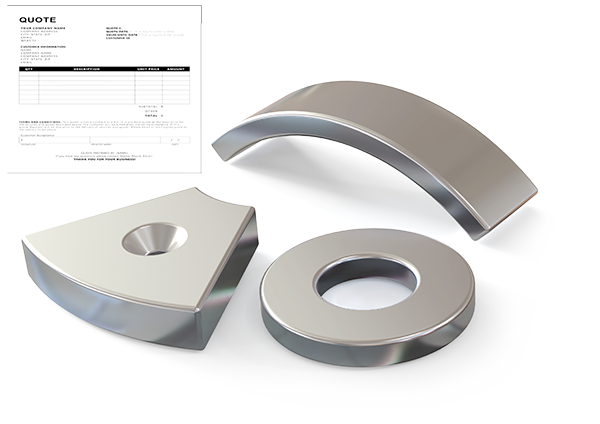
Pricing Breakdown
Custom magnets are a regular part of magnet sourcing and often more affordable than you may expect.
The total cost typically breaks down into three main components:
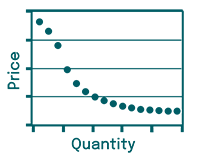 |
1. Order Volume & MaterialsPricing depends heavily on order quantity and material choices, both the magnetic material and the coating/plating. Making a small batch costs more per magnet because it often requires the same amount of production setup and process checks as a high-volume run. With fewer parts, those fixed setup and oversight costs are spread across a smaller quantity, which increases the per-piece price. Larger orders distribute those same costs across more parts, reducing the unit cost. |
 |
2. Machining and Labor Per PieceEach magnet must be precision-ground to its final shape. If your design includes features like countersink holes or tight tolerances, extra machining steps are required, which can increase the per-piece cost. For small magnets (under ~10mm), the grade or material type may not significantly affect the price. That’s because the machining and labor dominate the cost, making material grade a smaller factor at that scale. |
 |
3. Shipping SpeedMost magnets are “currently” manufactured in China. This is simply the reality of the industry due to China’s extensive magnet manufacturing infrastructure. When shipping from China you have two main shipping options: Air Freight – Faster, but more expensive. When you request a quote from Amazing Magnets, LLC, we can provide pricing and lead times for both options upon request. |
Minimum Order Quantities
The minimum order quantity varies based on the size of the magnet but is relatively low. Small parts involving intricate machining operations or high likelihood of breakage and loss during machining will have a higher minimum order quantity.
Production Lead-Times
 |
The production of custom magnets typically takes 40+ days. This doesn’t include shipping or customs processing. Customs paperwork and requirements change frequently and can affect the timeline. We’ll provide the most up-to-date estimate when we send your quote. |
Why Does It Take So Long?
For a variety of reasons, custom magnet orders are made from scratch (raw elements).
For a deeper look at the neodymium magnet manufacturing process, please see our article on How Neodymium Magnets are Made.
Here’s a brief overview of the steps involved in making custom neodymium magnets:
 |
Smelting:Raw elements are melted together to form specific alloys, based on the desired magnetic grade. This is where the grade of the magnet is locked in. |
 |
Powderizing:The molten alloy is cooled and processed into a fine powder. The powder is highly prone to oxidation and needs to be handled in oxygen free environments during the next two stages. |
 |
Pressing:The powder is magnetically aligned and pressed into blocks that roughly take the shape of the final magnet. This is where the basic magnet geometry and magnetization direction are locked in. Though the magnet is not fully magnetized at this stage. |
 |
Sintering:These pressed blocks are then heat-treated to densify the material and increase its ability to retain a magnetic field. |
 |
Machining:The sintered blocks are cut and precisely ground to their final dimensions. |
 |
Plating / coating:A protective coating of your choice is applied to the magnet to prevent oxidization. The most common being a 3 layer nickel-copper-nickel electroplated coating. |
 |
Magnetization:The final step is charging/magnetizing the magnet before packaging and shipping. |
Stock Magnets That Match Your Requirements
In some cases a magnet very close to what you need already exists. When you submit a quote, You can request that we check whether an off-the-shelf magnet matches or closely approximates your needs. Using a stock magnet can significantly reduce lead time.
How to Request a Quote
- Email us with your magnet requirements. Include any relevant part drawings or 3D models.
- We’ll review the request and follow up with any questions.
- If requested, we’ll check for stock alternatives that match your design.
- You’ll receive a formal quote including:
- Per-piece pricing
- Shipping options and costs
- Estimated lead time
If you’d like to proceed, we’ll send you a secure payment link or process your order by phone. We accept all major payment methods and ACH.
You’ll receive weekly status updates until your order ships.
Packaging
Parts can be packaged according to your requirements. Below is an overview of the most common factory packaging methods for custom neodymium magnets.
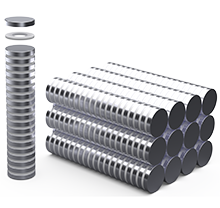 |
1. SpacersDepending on the size and strength of the magnet, we can place a nylon spacer between each magnet in the stack. The purpose of the spacer is to make handling easier when separating individual magnets. Very strong magnets can be difficult or unsafe to remove without spacers. If no preference is specified, we will decide whether spacers are needed based on our judgment. |
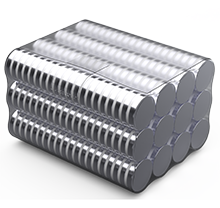 |
2. Plastic WrappingMagnets inside each inner box are wrapped as a bundle to protect them from moisture and humidity during storage. If needed, we can also vacuum seal the magnets upon request. |
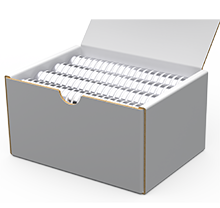 |
3. Stack Quantity and Inner BoxInner boxes are typically plain white folding boxes with a label on the outside listing the part name, dimensions, material specification, and box quantity. The number of magnets in each stack or row is determined by what fits best in the box, but this can be adjusted upon request if you need a specific stack quantity for counting or automated processes. |
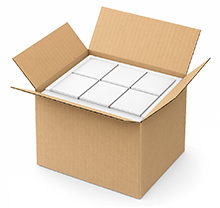 |
3. Outer BoxThe main shipping box is a durable two ply corrugated carton designed to withstand transport. For stronger magnets, the box may include a steel liner on the inside walls. This is required by international shipping regulations when magnetic field strength exceeds certain limits. The steel liner redirects and contains the magnetic field so the package can be shipped safely. |
Brittleness
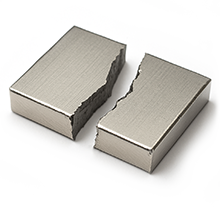
Neodymium magnets are brittle, similar to a ceramic tile, and must be handled carefully.
If two strong magnets are allowed to snap together, they can chip or crack, or the plating can become damaged or delaminated from the magnet material.
Learn More about Magnet Safety and Handling
Need help selecting the correct magnet?
Amazing Magents, LLC offers full scale product development support from initial concept to production and retail ready packaging.
Here’s a brief overview of some of what we offer.
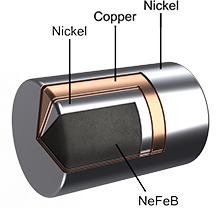 |
Help Selecting the Best Magnet CoatingWe help you select the best magnet coating for your product. |
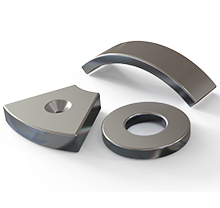 |
Magnet Material and Geometry OptimizationWe help you select the ideal magnet grade, shape, and orientation to meet your requirements. |
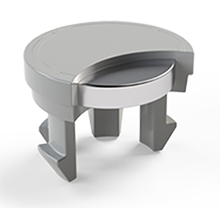 |
Finding the best way to attach the magnet securely to your device.We help identify the best way to integrate or fasten magnets into your design for strength, reliability, and long-term performance. |